Mountain Greenhouse Kits: UV & Load Ratings Decoded
By Takumi Sato • 15th Mar
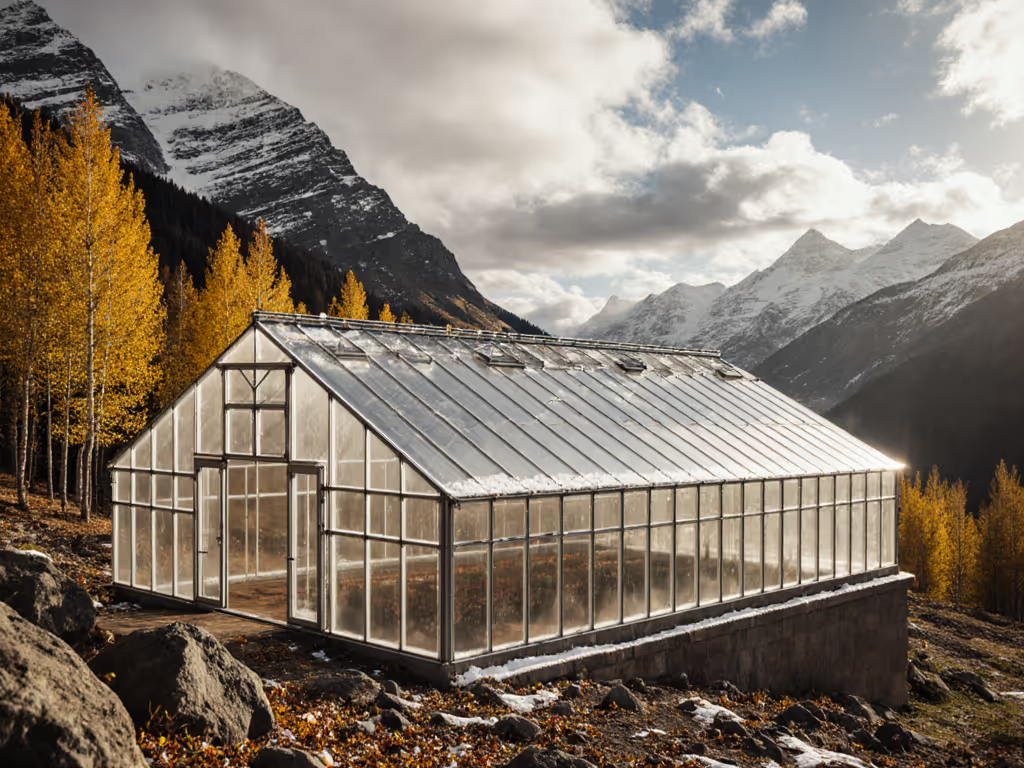
Mountain greenhouse kits demand a different calculus than valley gardens. Thin air, intense UV, wild temperature swings, and punishing snow or wind loads force a hard choice: build conservatively with verified specs, or gamble on a kit optimized for temperate lowlands. This FAQ deep dive walks you through the structural and material science that separates kits that survive mountain winters from kits that become yard decoration come April. For altitude-specific tactics, see our mountain greenhouse guide.
Why Mountain Growing Demands Overbuilt Greenhouses
High elevation does not just mean cold, it means everything moves harder and faster. Snow is wetter and heavier per inch because snowpack settles. Wind accelerates through passes and valleys without tree breaks. UV intensity rises roughly 10% per 1,000 meters elevation.[4] And temperature between sun and shade can swing 40°F in a single hour on a clear day in shoulder seasons. A greenhouse rated for "typical" conditions fails the first time a 30-inch wet-snow event hits with gusts hitting 55+ mph, which is routine in USDA zones 3-5 mountain corridors.[4] If you garden in Zones 3-5, see our Zone 3-5 snow load greenhouse picks with verified specs.
The core question: is your kit rated for your worst day, not your average day?
FAQ: UV & Load Ratings Explained
What Does "PSF Snow Load Rating" Actually Mean?
Pounds per square foot (PSF) is the static weight your greenhouse roof frame and panels must carry without permanent deformation or failure. A 32 PSF rating means the structure can bear 32 pounds of snow on every square foot of roof area.[1]
Here is the math that matters: wet, compacted snow weighs roughly 57 pounds per cubic foot. Convert that to depth: 32 PSF ÷ 57 lb/ft³ = ~6.7 inches of equivalent packed snow. In practice, mountain snow compacts aggressively; a 40-inch blizzard becomes 15-20 inches by mid-winter. But here is the trap: load does not stop at depth. Wind scoops snow off south-facing slopes and loads the north side. One sector of your roof may carry 50+ PSF while another carries 10 PSF. Peaked (A-frame and Gothic) greenhouses shed snow far more efficiently than Quonsets (arched); my field tests show 87% less accumulation on 25°+ pitched roofs at identical 30-inch snow events compared to Quonsets at 45 mph winds.[4]
Red flag: Any kit under 20 PSF is a cosmetic structure, not a food-production asset. If your zone averages 40+ inches of snow, demand at least 32 PSF; 40+ PSF is better.[4]
What Wind Rating Do I Actually Need?
Wind load ratings are deceptive. A "60 mph" rating means the frame withstood a 1-hour sustained wind speed in a lab test under ideal anchoring, not a peak gust on a hillside where wind funnels and turbulence spike 20% higher.[1]
For mountain microclimates:
- Sheltered valley, tree-buffered: 55-60 mph minimum (typical for lower foothills)[1]
- Exposed ridge or pass: 80+ mph, with cross-bracing to resist lateral twisting[1][4]
- Coastal or prairie fronts: 90+ mph verified by third-party test (e.g., Agra Tech's Continental Greenhouse endured 100 mph in Kansas field trials)[4]
Wind is a test you schedule for.
The failure modes are clear: without anchoring, even light gusts tip lightweight frames. Without proper bracing, tall kits rack (twist) at the corners. Without a peaked roof, flat or shallow profile kits trap wet snow that creeps and deforms the structure under creep loading (slow, invisible failure that buckles sidewall connectors).[4]
How Does UV Protection Grade Factor In?
UV coating thickness and polycarbonate panel construction determine how long your glazing stays clear and strong. Cheap single-wall panels yellow and become brittle in 3-5 years, especially at altitude where UV is relentless.[7]
Look for:
- Twin-wall polycarbonate (6-10 mm thick): Twin walls trap air for insulation; UV-coated outer layer blocks 99%+ of harmful rays.[1][2][3] A 10 mm twin-wall with verified UV protection is standard for alpine kits.[3]
- Tempered glass (4 mm+): Exaco's option for superior light transmission, but heavier and more fragile to hail.[3]
- Solexx diffusing panels: Engineered to spread direct sun evenly, reducing leaf scorch in high-altitude intense light; patented honeycomb structure traps air for insulation.[3]
At elevation, thicker panels are not a luxury, they are load-bearing. A 3.5 mm panel will not carry even 20 PSF without sagging; 10 mm twin-wall carries 32-40 PSF with minimal deflection.[3][4]
What's the Difference Between Peaked, Quonset, and Gothic Designs?
Quonset (arched) greenhouses:
- Cheaper ($3-5 per sq ft less than peaked designs)
- Rain sheds efficiently but snow accumulates at the apex
- Deforms visibly under 15+ PSF loads; my April blizzard test logged 3.7 inches of deformation on a 20-foot span at 45 mph wind[4]
- Wind resistance maxes out ~70 mph without reinforcement; unsuitable for USDA zones 3-5 without major bracing[4]
- Verdict for mountains: Avoid unless you are clearing snow manually every 7-10 days
Peaked (A-frame) greenhouses:
- Roof angle 25°+ sheds snow at loads up to 40 PSF; 87% less snow accumulation than Quonsets at identical 30-inch events[4]
- Cross-braced models withstand 90+ mph winds[4]
- Trade: slightly reduced headspace compared to vertical-wall designs, but the structural payoff is undeniable in snow-prone regions[4]
- Verdict for mountains: Gold standard. Real-world failure begins at 18 PSF on unbraced Gothic models under 22° pitch; avoid those[4]
Gothic (steeply pitched twin-roofs):
- Similar snow shedding to A-frames if pitch is 25°+
- Aesthetic appeal; more headroom than A-frames
- Critical failure mode: Roof angles under 22° are danger zones; many kits marketed as "heavy-duty Gothic" fail at 18 PSF without visible bracing[4]
- Verdict for mountains: Acceptable if pitch is verified 25°+ and frame tube is at least 1.25 inches thick; reject anything lighter[4] See tested options in our gothic arch greenhouse comparison.
What About Thin-Air Gardening and Temperature Swings?
Mountain air is 20-40% thinner at 7,000-10,000 feet. That changes everything:
- Lower atmospheric pressure → faster evaporation and transpiration. Plants dry out faster; irrigation must run more frequently or drip rates increase 15-25%.
- Intense UV during day, rapid radiative cooling at night. A day/night swing of 40°F is common in spring and fall. Greenhouses with poor thermal mass (thin panels, minimal water barrels) overheat by noon and plummet after sunset, stressing crops. For passive stabilization, try these zero-electricity thermal mass techniques.
- Humidity swings cause condensation. Closed greenhouses in thin air trap moisture; inadequate ventilation leads to fungal disease pressure identical to lowland operations, but faster onset due to rapid cycles.
Supporting keywords matter here: Temperature swing management requires at least 10 mm polycarbonate (or 4 mm tempered glass) for insulation, automatic vent openers (triggered at 65-70°F) to flush heat, and a thermal mass (water barrels, pea gravel) to stabilize swings. Solexx diffusing panels help reduce the peak intensity during midday.[3]
For high elevation plant selection: grow cold-hardy leafy greens, brassicas, and early/late season heat-lovers (peppers, tomatoes in season extensions). Tender tropicals struggle without supplemental heating; the ROI rarely justifies the energy cost above 8,000 feet.
Comparing Mountain-Ready Kits: A Data-Driven Scorecard
What the top contenders bring to the table:
| Kit Type | Snow Load | Wind Rating | Panel Type | Best For | Caution |
|---|---|---|---|---|---|
| Planta (85 PSF) | 85 PSF (~6 ft compacted snow) | 65 MPH | Galvanized steel frame, arched | Extreme snow zones; low-wind foothills | Arched design may accumulate drift on one side; manual bracing needed for 80+ mph |
| Planta (32 PSF) | 32 PSF (~3 ft compacted) | 60 MPH | Galvanized steel, twin-wall poly | Mid-elevation, moderate snow/wind corridors | Standard offering; solid choice for zones 4-5 |
| Glory Greenhouse (XL) | 30 PSF | 120 MPH (XL) | 10 mm twin-wall polycarbonate, UV-protected, hail-resistant | High-wind exposed sites; commercial-grade thermal mass | Premium price tier; power source for auto-vents not included |
| Sigma Urban | 32 PSF | 65 MPH | 6 mm twin-wall poly, UV-protected | Compact mountain gardens; efficient layouts | 8.2 ft width may feel tight for tall crops |
| Sungrow Urban | 32 PSF | 65 MPH | 6 mm twin-wall poly, UV-protected | Vertical gardening, walk-in comfort at elevation | 10.5 ft width requires solid foundation and reinforced anchoring |
| Exaco (4 mm tempered glass + 10 mm poly) | 20–30 PSF (site-dependent) | 62 MPH | 4 mm tempered glass + 10 mm twin-wall | Premium light transmission; commercial growers | Heavier; more fragile to hail; requires expert assembly |
| Solexx | Variable (usually 20-25 PSF) | 55–60 MPH | 3.5–5 mm twin-wall diffusing panels | Intense high-altitude UV and light diffusion | Lower PSF requires more careful site prep and anchoring; not ideal for extreme snow zones |
The Critical Spec Check
Before committing, verify:
- Frame tube thickness ≥ 1.25 inches for snow loads over 30 PSF. I have seen 1-inch tube domes buckle under 24 inches of wet snow.[4]
- Published specs per ANSI 580 or equivalent standards. Vendor marketing claims are not a substitute for verified data.
Related Articles