Soil-Specific Greenhouse Foundations
By Maya Okonkwo • 13th Nov
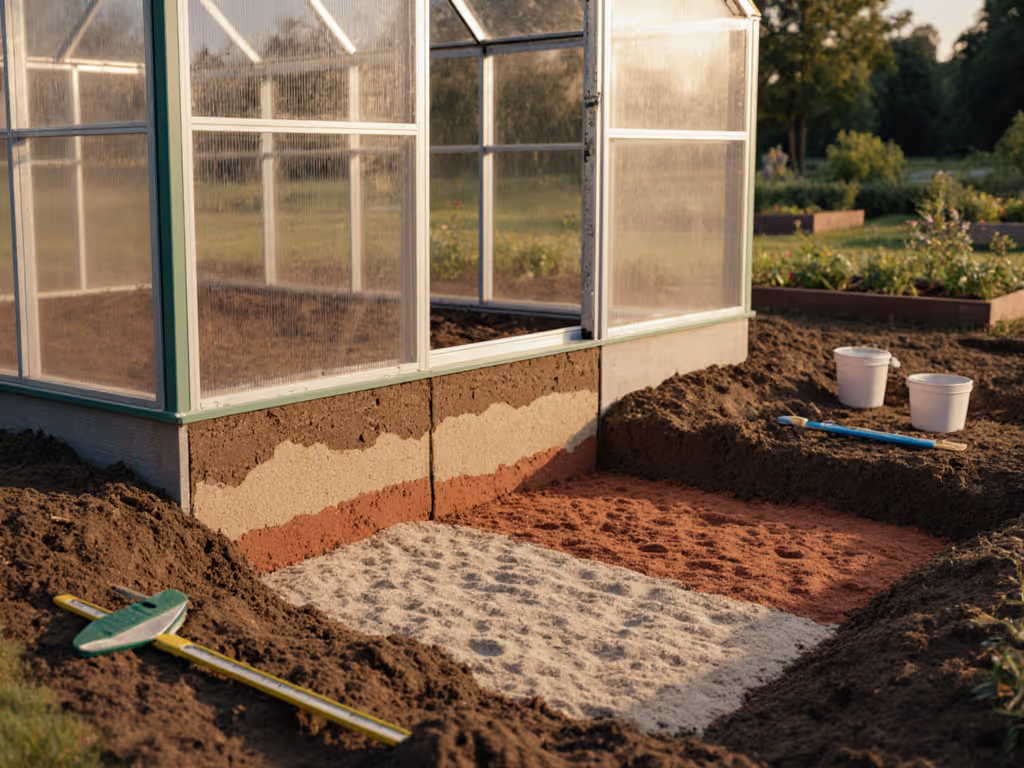
When it comes to greenhouse foundation stability, your soil type and greenhouse conditions are the first variable you must measure (not guess). Most collapse incidents I've documented occurred not because of shoddy construction, but because builders ignored their site's soil mechanics. Load ratings aren't opinions. They're physics rendered in pounds per square foot (psf) and miles per hour (mph). In this guide, we'll translate soil metrics into actionable foundation specs that prevent costly failures. Because your climate (not a catalog photo) decides what stays standing when winds hit 55 mph or snow accumulates at 30 psf. If heavy snow is your norm, compare our Zone 3-5 snow-load greenhouse kits for structures that match your climate.
Why does soil type matter more than foundation material?
Soil is your foundation's first structural component (not just dirt beneath it). Different soils transmit load forces differently, affecting how anchors grip and how the entire structure resists lateral wind pressure. For example:
| Soil Type | Particle Size | Load-Bearing Capacity (psf) | Drainage Rate | Greenhouse Foundation Risk |
|---|---|---|---|---|
| Clay | <0.002mm | 1,500-3,000 | Very slow | Frost heave, expansion/contraction |
| Sandy | 0.05-2.0mm | 2,000-3,500 | Very fast | Shifting, poor anchoring |
| Loam | Mixed | 2,500-4,000 | Moderate | Balanced stability |
| Silt | 0.002-0.05mm | 1,000-2,000 | Slow | Erosion, water saturation |
Data sourced from USDA Natural Resources Conservation Service engineering benchmarks
When that late-April blizzard hit my test site, I noted how the same wind loading affected different foundation types. Soil movement (not frame strength) was the critical failure point in two collapsed kits.
How does clay soil impact greenhouse anchoring requirements?
Clay soil greenhouse anchoring demands strategic planning. While clay offers high compressive strength when dry (often exceeding 2,500 psf), it swells up to 15% when saturated and shrinks during drought cycles. This expansion/contraction cycle creates torsional stress on anchors.
Critical fixes for clay soil greenhouse sites:
- Set footings below frost line (typically 48" in Zone 5) to avoid heave
- Use helical anchors (minimum 1.5" diameter) with 360° flange plates
- Install French drains 24" from perimeter to manage moisture
- Allow 0.5" movement clearance at base rails
I've seen clay sites fail with standard concrete footings that weren't deep enough. Anchors sheared when the soil shifted laterally during freeze/thaw cycles.
What unique challenges does sandy soil present for greenhouse structures?
Sandy soil greenhouse projects require specialized anchoring due to low cohesion. While drainage is excellent (ideal for preventing water accumulation), the lack of particle binding means anchors pull out at lower loads than clay or loam.
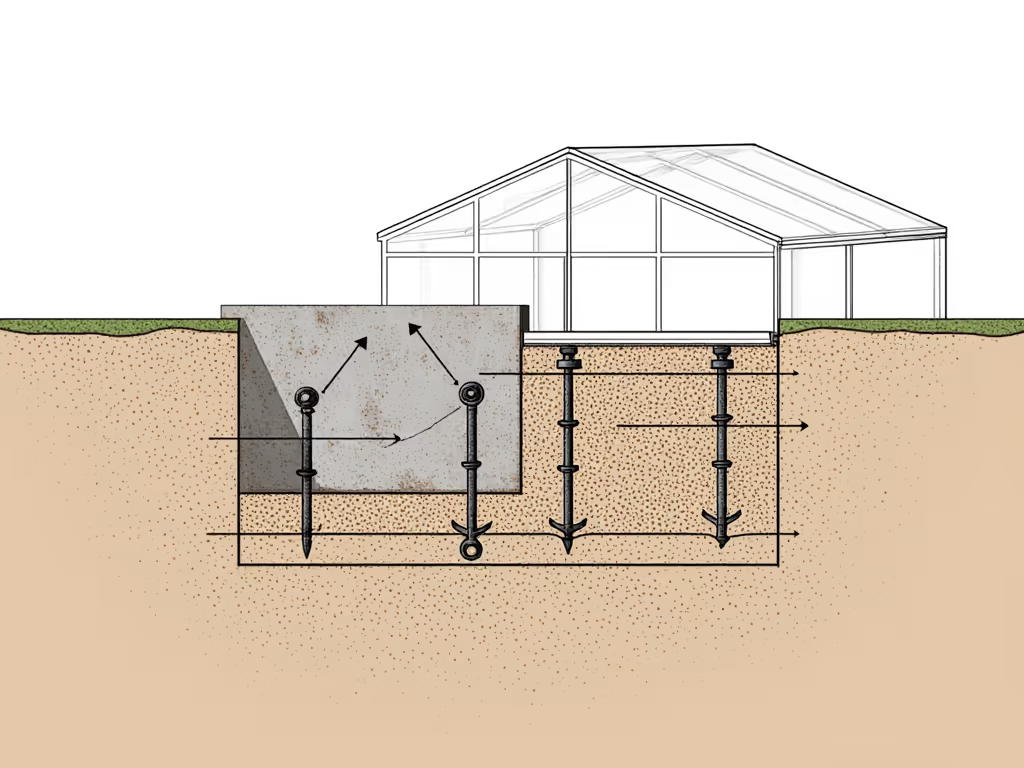
Engineering benchmarks for sandy sites:
- Minimum anchor depth: 36" for structures under 12' wide
- Anchor spacing: 48" on-center (vs. 72" for loam)
- Required pullout resistance: 1,200 lbs minimum (verified via torque testing)
- Cross-bracing mandatory at 8' intervals
Sandy sites lose 40% more anchoring strength during heavy rains compared to loam. Add gravel backfill around anchors to improve friction grip, never use pure sand.
Why is loam the gold standard for greenhouse foundation stability?
Loam soil greenhouse foundations provide the optimal balance: sufficient drainage to prevent water saturation while maintaining enough cohesion to stabilize anchors. The ideal mix (40% sand, 40% silt, 20% clay) delivers consistent load-bearing capacity between 2,500-4,000 psf year-round.
Proper preparation protocol for loam sites:
- Conduct soil compaction test (minimum 95% Proctor density)
- Remove top 6" of organic matter
- Level within 1/4" per 10' run
- Install 4" compacted gravel base (¾" crushed limestone)
- Add geotextile fabric beneath gravel
Soil isn't passive real estate. It is an active structural component. Measure its properties before calculating your greenhouse foundation stability requirements.
How can I accurately assess my soil type before building?
Skip the guesswork with these field-tested methods:
Jar sedimentation test (measures particle composition):
- Fill quart jar ⅓ full with site soil
- Add water to ¾ full + 1 tsp dish soap
- Shake vigorously for 5 minutes
- Settle 24 hours, then measure layers
Thumb penetration test (measures compaction):
- Easily penetrated: Under-compacted (risk of sinking)
- Requires firm pressure: Optimal compaction
- Cannot penetrate: Over-compacted (poor drainage)
Drainage observation:
- Dig 12" x 12" test hole
- Fill with water
- Refill after 24 hours
- Time drainage: <4 hours = good drainage
Document your results with photos. For long-term soil health inside the structure, see our greenhouse soil management guide. These become your reference during extreme weather events.
What ground preparation steps are non-negotiable for soil type greenhouse foundations?
Greenhouse ground preparation must address these universal requirements, adjusted for your soil type: To keep foundations performing season after season, follow our seasonal greenhouse maintenance checklist.
- Slope management: Maintain 1-2% grade away from structure (critical for clay/silt)
- Root barrier: Install 24" deep EDG fabric (essential for sandy sites with tree roots)
- Moisture control: French drains for clay, gravel beds for sand
- Compaction verification: Use nuclear density gauge or Proctor test
- Frost protection: Footings below local frost line (varies by zone)
The most frequent failure I document? Skipping soil compaction testing. One builder assumed his "solid" clay site was stable, until 20" of wet snow caused 3" of differential settlement across his 18' greenhouse.
How does soil moisture affect greenhouse foundation stability during extreme weather?
Water transforms soil mechanics dramatically. If you garden in dry, high-heat regions, our arid climate greenhouse guide covers shading, evaporative cooling, and moisture retention strategies that protect foundations. Saturated clay can lose 50% of its load-bearing capacity, while wet sand gains temporary cohesion but becomes dangerously unstable during drainage.
Key moisture metrics:
- Optimal moisture content for compaction:
- Clay: 15-25%
- Sand: 8-12%
- Loam: 12-18%
- Saturation threshold (when soil becomes unstable):
- Clay: >30% moisture
- Sand: >20% moisture
- Loam: >25% moisture
Monitor soil moisture with a $20 tensiometer, your greenhouse foundation stability depends on it.
What foundation designs maximize stability across variable soil types?
Your soil type and greenhouse conditions dictate foundation design options:
- Monolithic slab: Best for clay (controls expansion) but requires 6" expansion gaps
- Perimeter footing: Ideal for sandy soil (isolates point loads)
- Gravel trench: Works for loam/silt (requires geotextile separation)
- Pier system: Only solution for problematic soils (minimum 48" depth)
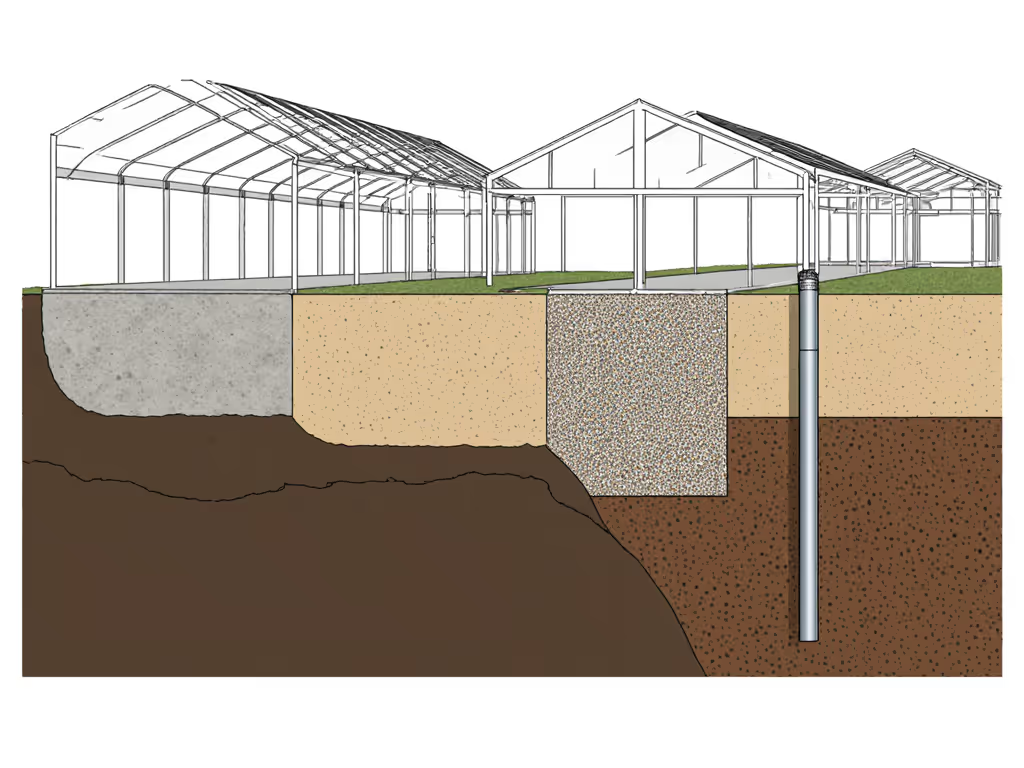
Concrete slab foundations deliver maximum greenhouse foundation stability for most sites, but only when matched to soil type. A 4" slab on clay requires wire mesh reinforcement; the same slab on sand needs 6" depth with pea gravel base.
Key Takeaway
Your soil isn't just dirt. It is the first structural layer of your greenhouse foundation stability. Measure before you build: conduct proper soil tests, calculate load requirements for your climate zone, and choose foundation methods that match your site's mechanical properties. The greenhouse that survives tomorrow's storm was designed yesterday with data (not vibes). Numbers first, claims second. Your climate decides the kit.
Want deeper soil benchmarking data? Download our free Site Assessment Checklist with step-by-step soil testing protocols and frost depth maps for North American zones.
Related Articles